Tuesday, 17 April 2018

Walking into Clarksdale


THE Crossroads
If you walk into Clarksdale along the highway 49 you will come to a crossroad with what used to be highway 61. Today highway 61 goes around the bypass but it was here when one day Robert Johnson came to the crossroads one night with his guitar on his arm. He met the Big Black Man, who said in unearthly voice: “Gimme your guitar Robert, I'll tune it for you”. The Big Black Man turned a few keys, gave it back and said: “Now no woman can resist you, man. See you again at The Three Forks.” Then he vanished in thin air, one could only smell something like burning brimstone and hear barking of hounds, very deep as if from underground.
These days you are much more likely to drive into Clarksdale, even if you are just a musical pilgrim wanting to see the place. There is a monument made up of guitars on that famous crossroads. And if you have a car and are a blues pilgrim there, you can also visit Dockery Farm, where an information board says that it is there that blues music was born. Charlie Patton – its earlies recorded performer – worked here for some time. Charlie Patton taught Willie Brown how to play and Willie Brown taught Robert Johnson, who, as is well known (to some) was THE blues singer.
Nobody knows exactly when the blues was born but it is assumed that it was sometime at the beginning of the 20th century. Nobody before that time had written this kind of music in musical score (clearly nobody thought music of the black ghettos was worthy of that honour) and the earliest recordings date from 1920ties. It soon turned out that there is some demand for those recordings and there is some money to be made there. Consequently quite a number of them were made and not for any ethnographic collection but for a real audience. There are recordings of the blues in Dixie jazz style, like those of Louis Armstrong, there are so called “classic blues” recordings, which meant a voice (often female, like that of Bessie Smith) accompanied only by a piano, there also are recordings of the so called “country blues”, which meant a voice (this time usually male) accompanied only by a guitar. The guitar on those recordings is played in a most unusual way, which didn't have much in common with the way the white men played it. It was played with a bottleneck, which was a metal or glass tube (sometimes a real neck knocked out of a bottle) put on a little finger of the left hand, which made possible the characteristic blues glissando. It was played with the strings tuned “out of tune”, or rather in tunings different to that of the classic guitar. In 1920ties a resonator steel guitar was invented and used by the blues bottleneck players and in 1930 first electric guitars appeared. The electric guitar was quickly picked up by blues players from Chicago and Memphis, who developed the style known as “city blues”. It was usually played by a four-piece band: drums, bass guitar, electric slide guitar and a harmonica. In the 1950ties a young musician from Memphis (a non-Black, which was important) picked up this style, sped up the tempo, called it “rock and roll” and sold it to non-Black audience. From then on the blues started to conquer the world.
Birthplace of the blues?
The new music quickly became fashionable on the other side of the ocean, especially in London (from where mentally is much closer to New York, which after all is only “over the pond”, than to Paris, which is “overseas”). In the 1960ties completely white blues bands were created in London, John Mayall's Bluesbreakers, The Rolling Stones, Peter Green's Fleetwood Mac. These musicians wanted to get to the source so they travelled “over the pond” to visit the places where the country blues was played, to listen to the tales of the old musicians, to collect the old records.
It soon turned out that among those old scratchy records there are some that had some unusual qualities. One could listen to them and never get bored, like listening to Bach. They had one thing in common: they were all recorded by one Robert Johnson. Some people started looking for him. Perhaps he still played in an old tavern forgotten by everybody? Or perhaps he stopped playing and occupied himself with something else buy could be persuaded to do some recordings? The search ended when people who knew him well were found and the story of Robert Johnson came to light.
Robert Johnson was brought up in the area known as Mississippi Delta. The name is misleading because this is not the actual delta of the great River but the flat area on its left side between cities of Memphis and Vicksburg. It is a fertile plain where cotton is grown. It is here that the country blues was played. His white enthusiasts nick named Robert Johnson “King of the Delta Blues”, but he was actually more than this. All of his track (only 29 of them are known) have been recorded like “country blues”, with an acoustic guitar as the only accompaniment, but in his style all elements of Chicago “city blues” are present. One can almost say that this musician brought up among cotton fields is the grandfather of all rhythm and blues and rock and roll. And scores of guitarists from all over the world making pilgrimages to the famous crossroads seem to confirm that this is the source.

Mural of Robert Johnson in Clarksdale
Robert Johnson lived for some time in Clarksdale but The Three Forks used to stand outside the town of Greenwood, some distance away. Since the fateful meeting at the crossroads he had a lightning career, travelled around the Delta and sometimes beyond. People say that his music was enchanting, that indeed no woman could resist him. In some songs he bragged about having a woman in every town from Vicksburg to Tennessee. Indeed when he eyed a woman in The Tree Forks, where he played together with Honeyboy Edwards and Sunny Boy Williamson, it seemed that she wouldn't resist either. However, she happened to be the woman of the tavern owner. Both musicians that were there at the time recall the event. Somebody gave Robert an opened bottle of whisky but Sunny Boy sensed something suspicious and knocked this bottle out of his hand saying: “Never drink from an open bottle!” Robert got very angry with Sunny Boy, somebody gave him another bottle. The next day Robert Johnson was dead.
Today many guitarists travel to Clarksdale just to see the crossroads. Some of those guitarists are quite famous, like Jimmy Page and Robert Plant, who even recorded an album entitled “Walking into Clarksdale”. Some of those musical pilgrims also go to Dockery Farm, where next to the board informing about the birthplace of the blues there is a button, pressing of which will cause some recordings of Charlie Patton to be played. Nobody goes to The Tree Forks, though. Some people tried to find the place but couldn't. Honeyboy Edwards in his autobiography explains why this is so: sometime after the famous event a tornado came and took the whole building, so that nothing remains today.

Cigar box guitar


You will find this story, and many others, in my book "ASK A GLOBETROTTER".


Monday, 29 January 2018

Indians of the Amazon - where have they gone?

Travel in the Amazon
Buy yourselves hammocks before you get on the ship.”
This is the Amazon, more different from the rest of Brazil than the rest of Brazil is from Europe or America. There are no roads here, only rivers, one has to travel by ship. Ships have a few cabins but most of the passengers just hang their hammocks from the ceilings above the decks. This is what one sees most of the time when one travels in Amazon – hammocks dangling everywhere. Everybody brings their own hammocks and we – just arrived from Europe – have to buy them before we go. In Manaus there is a whole street of shops where one can buy hammocks. Various hammocks: expensive and cheap, heavy and light, made of different materials and of all possible colours. They are folded on shelves or hanging from the ceiling, one can check whether they are nice to touch. We have been advised to buy big and comfortable hammocks because we'll be dangling in them for several days.
Finding a ship that goes in the right direction is another problem. Timetables don't exist here, one has to go to the right quay (one has to know which one is the right one) and ask around: which of the ships moored there goes where, on which day, at what time. Tickets are purchased an a table standing at the quay. Having purchased the ticket one gets a band around the wrist and can board the ship. Having entered one has to find a place to hang a hammock. Decks on Amazonian ships are spacious and always have a roof under which there are rails and hooks especially for hammocks. During holidays before the New Year ships are especially crowded and only with difficulty we find room for our hammocks on the uppermost deck. All around us people with copper coloured skin, whole multi-generational families. Amazing how young some of the mums are, they seem to be teenagers, but they look after their babies as they should. They breastfeed in their hammocks taking no notice of the people around.
Almost all the passengers have copper coloured skin and Indian features but officially they are not Indians. Officially there are no Indians living on the shores of the Amazon River. They are not called “Indios” but “caboclos”, or “river people”.
Our journey from Manaus to Tefé lasts three days. This could be shortened if someone is in a hurry and has a lot of money. This applies to the Western tourists who have short holidays and want to visit Mamiraua National Park. This is the park that covers the part of the jungle regularly flooded by rising waters of the river and tree trunks stand in the water. This is the habitat of the famous uakari monkey that has white fur and red face. For those tourists in a hurry a special floating hotel has been built. The tourists fly to Tefé, from the airport they go by taxi directly to the port, from which speedboats take them to the floating hotel and local guides show them the secrets of the jungle. After a couple of days they speed back to the airport without stopping at Tefé.
Inhabitants of Boca de Mamiraua
The local guides are caboclos who lived there for generations. They have copper-coloured skin and Indian features but they arenot Indians. They not daft either. They figured out that if they can work as guides for tourists who pay a lot of money to stay in a floating hotel, they probably can welcome other tourists, who have a little less money but a little more time. They can welcome these tourists in their own casa de caboclo, or “caboclo home”. This is exactly what the inhabitants of a village called Boca de Mamiraua decided to do. And this is where we decided to go.
Boca de Mamiraua lies at the very edge of an inland delta between Japura and Solimoes rivers. This inland delta is a flat area full of canals and islands that are flooded every year but are covered in dense forest. Houses in the village have to stand on high stilts as here nobody can say they didn't expect the flood. Sometimes there is more water than usual and the first floor of the houses are flooded, too. Only some houses have a second floor and in times of exceptionally high water they have to house not just one family but also the neighbours. The church standing in the middle of the village is of course also on stilts. In Boca de Mamiraua it is an evangelical church where music is accompanied by electric guitars. It must be interesting to hear a reading about Noah when the church is up to its neck in water. Kitchen gardens with onions and dill are in boats filled with soil and placed on stilts, high above the ground. There is a little manioc field behind the village but it has to be harvested before the next flood, not as in other Amazonian villages, where manioc is harvested whenever needed, all year round. Fish, on the other hand, are plentiful always. And what fish! A pirarucu can be as big as a grown man. It cannot be eaten at once, it has to be cut into sheets and dried like washing in the sun, which is also plentiful. Later the dried fish-sheets can be sold in Tefé. Fish of this size cannot be angled, it has to be speared and still jumping in anger pulled into a canoe. This is the Indian way of fishing, although the inhabitants of Boca de Mamiraua claim they are caboclos, not Indians.
Fish hung out to dry
Fish and manioc are staple foods in Amazonia. In Tefé on the market square one can eat a freshly fried piranha in an open air kitchen. Whole families work in those kitchens, including teen-age children. In one of them a teen-age helper sat to eat with us. She looked wide-eyed at Justyna and asked: “Where do such beautiful people come from?” I am of course flattered when somebody speaks like that about my daughter but I guess there is deeper meaning here. Justyna with her North-European features and blond hair looks like a model from a fashion mag, whereas the inhabitants of Tefé are of course not Indians at all, but they do look like Indians.
Somebody told me that there is a Polish priest in the cathedral of Tefé so I went to the office there, started talking Polish and somebody answered; this was father Piotr. Poles are not a common sight in Tefé, so we were immediately invited for dinner. It was served by a lady of dark complexion and clearly Indian features. Father Piotr told us that she came from a village of Ticuna Indians but she is ashamed of it and says that she is not an Indian. After all everybody in the town looks like that.
A couple of days later father Piotr took us to the village of Ipapuku on the other side of the Lake Tefé. The village stands on higher ground, houses don't need to be on stilts. The inhabitants say the are caboclos, which means they consider themselves ordinary civilised Brazilians, not Indians. They even have a flush toilet in one of the houses, which is where I am led (quite far) when the need arises. The central building of the village is a little church, neatly maintained even though a priest comes only sometimes, once a few months. “I'll have to come here once to celebrate a mass for them” said father Piotr seeing the neat church. When we arrived the villagers were busy producing granulated and roasted manioc. The procedure is exactly the same as described by travellers who visited Indian villages deep in the jungle, although here some mechanical implements were used to make the work easier. Raw manioc was grated in a mincer and then pressed into characteristic socks weaved from palm fibre. I have seen socks like that in pictures from Indian villages in old travel books. Manioc's poisonous juice is squeezed out in those socks. Afterwards granules are formed inside a cylinder turned by hand. Later, the granules are sieved to sort various sizes and finally roasted on a huge pan.
Clearing the jungle in Ipapuku
We were also shown a manioc field. This is on a spot where forest was burned out a few years earlier. Nearby, another spot is being burned out to make room for another field when the present field becomes less productive. This has been a time honoured economy of Amazonian Indians – a plot of burned out forest was used for some years but when it became less fertile – it was left fallow, then the forest returned while another plot was burned out for agriculture.
Another day father Piotr took me to a town called Alvaraes. He said that in the 18th century this was a famous slave market and actually this is what the name means. This name is a witness of an important aspect of history of this part of the world.
The Portuguese didn't come to the New World to seek gold, as Spaniards did. The Portuguese wanted to cultivate sugar which could be sold in Europe for gold. They wanted to cultivate it but it does not mean they wanted to do all the physical work themselves. The plantations were to be worked by slaves. Some of the slaves could be brought from Africa, bought from African princes on the coast of Guinea. The earliest Portuguese sugar plantations were started on uninhabited islands like Madeira and Cape Verde and were worked only by slaves bought on African coast. The African slaves were also taken to Brazil but considering costs of transport across the ocean, they weren't cheap. On the other hand there were natives in Brazil, too. They didn't have their own slaves to sell, as the African princes did, but they had war prisoners which were captured in order to be tortured and – if they proved that they were brave enough while tortured – eaten, so some of that bravery would enter those who ate them. This was of course a barbarous custom in the eyes of the Portuguese who thought saving lives of these prisoners was a good deed. It wasn't difficult to persuade the captors to part with their prisoners because all Indians desired certain metal that the Portuguese possessed. To obtain this metal they would not only part with their prisoners but they would gladly go again on the war path to capture some more.
Roasing manioc in Ipapuku
The metal they so badly desired had almost miraculous properties. With an axe made of it one could cut a tree in almost no time at all, or split somebody's head in a second. A knife made of it could easily cut meat or go right into a heart of an enemy. Those who possessed this metal could much easier win a war and bring some more prisoners whose lives could be then saved in exchange of some more axes and knives.
Some of those prisoners sold to white settlers were women. One can guess that quite a lot of them were women as it was more difficult to catch men because men tended to defend themselves. It was much simpler to attack a village, kill men, bind women and children and take them away. One can also guess that the white purchasers used those women not only for hard labour. The result was a population of people of mixed race and rooted in both cultures, who felt in the bush just as much at home as in the white man's town. Soon it was those people who organised expeditions into the interior to catch more prisoners. In the 17th century those expeditions, called bandeiras, were organised on a regular basis and their participants, called bandeirantes, are today considered discoverers of Brazilian interior. And the Amazon was an open waterway into the interior.
It is of course terrible that people who considered themselves “Christians” behaved so badly. One has to remember, however, that the people who considered “Christianisation” as a pretext of a conquest are only one side of the story. In history of any country there is a tension between gangsters who have power and independent pressure group who tries to restrict the power of those who rule. In the 16th century Europe this taming pressure group was without doubt the Church, both in Spain and Portugal it was the Roman Catholic Chuech. In those days there was no police who could be called if a husband mistreated his wife, but there was a priest who had no sanction but the penance given at confession. There were no parliaments which could restrict the power of kings but there were priests who who reminded the kings that their power has to respect the message of Gospels. The message of Gospels was that all people are children of God and therefore cannot be enslaved and treated like animals.
A street in Tefe
Priests followed conquerors into colonies. The conquerors wanted to get rich but the priests who followed were often members of of religious orders committed to poverty, like Dominicans, Franciscans and Jesuits. These people did not go to the colonies to get rich. They went there to persuade the natives to stop practices which in Europe were not considered appropriate, like torturing and especially eating prisoners of war, or having more than one wife. They went there also to protect the natives from the excesses of white colonisers. The most famous of those was a Dominican friar, Bartolomeo de las Casas, who wrote a book that was much discussed at the time. The most influential missionaries in Brazil were the Jesuits. They were influential at the highest levels of power, sometimes they even managed to persuade kings to ban or at least restrict slavery. It depended on the period because the sugar-planters were also influential and at times managed to persuade the king to revoke the anti-slavery laws. For most of the colonial period in Brazil it was lawful to enslave prisoners taken in defensive wars or those who were “ransomed” and thus saved from torture and death.
The Jesuits also organised missions far from white settlements. In those settlements they gathered the baptised peaceful Indians. In theory this was to protect those Indians from slavers because the baptised Indians weren't aggressive (so there could not be a “defensive” war against them) nor did they eat any prisoners who could be “ransomed” and saved from death. Unfortunately it did not always work because for the bandeirantes the fact that Indians were God-fearing was of little importance. What was more important was that many of them were gathered in one place and if they weren't aggressive, they wouldn't fight back. At certain periods the Jesuit missions were the main targets of the bandeirantes. To justify their actions the bandeirantes, as well as the planters, spread the word of the supposed abominable behaviour of Jesuits in their missions. They kept repeating their accusations so persistently that somebody in the end believed them and as a result the Jesuits were banned from Brazil after several centuries of work.
Is it surprising then that in this situation the Indians preferred to say that they are not really Indians? Whatever their origin, they preferred to claim that they weren't Indians and should not be enslaved. Especially if they were good Catholics, had a church in the middle of the village and looked after it even though there was no priest enywhere near.
Indians of Nova Esperanza
The Indians who lived by the Solimoes in the old days were called Cambeba by the Portuguese and Omagua by the Spaniards. Early travellers noticed that the unlike other Amazonian tribes the Cambeba did not walk around naked but wore cotton clothes. They are also credited with the discovery that hugely influenced the motor industry – they were the first to find use for the juice of rubber trees. However, when the Portuguese hunted slaves on the Solimoes the Cambeba moved upriver, to the missions of Spanish Jesuits from Peru. So the sources say, anyway. Other tribes found refuge in the upper courses of other rivers, avoiding any contact with white people. They don't want any iron tools and just to drive the point home they shoot poisoned arrows at anyone who turns up in the vicinity of their villages. All Indians vanished from the Solimoes, only a few caboclos stayed, and caboclos, as everyone knows, are not Indians.
There was one more person invited to dinner at father Piotr's when we were there. This was brother Marius, a Polish Franciscan who lived in Tefé. He also showed us around the town. He took us to the part of the town which is regularly flooded and therefore all houses and the paths leading to them are on stilts. He also took us to CIMI, or Conselho Indigenista Missionário, which means Indian Missionary Council. There we were welcomed by a group of young people who do missionary work in this area. They were of dark complexion like all other inhabitants of Tefé but unlike the others the young people at CIMI admitted they were Indians. They said that since the leftist government of Brazil found some funds specifically for Indians, for example for education of their children, some groups suddenly remembered that they were descendants of this or that tribe. Sometimes they don't remember their tribal language, but so what? If they are accepted as Indians, their village is declared an Indian reservation where strangers can only enter with permission from the government agency that is supposed to deal with Indians and make sure they are safe. This is the case even if the village is no different from a neighbouring caboclo village.
One day we went with brother Marius in a Franciscan Land Rover to visit a few villages in the vicinity. One of those villages stood on a high shore over the Solimoes. A village as any in this area. Houses had low floors because the land they were built on was well above the regular floods. There was an impeccably maintained church in the middle of the village. As we came there, some young people were gathering, beautiful dark skinned girls, boys in sunglasses, they were about to practice something. As we came, somebody ran to call the touchan. Brother Maruis said that if they are calling a tuchan, this must be an Indian village, otherwise that person would be called “a president of the village council” or something of the sort. The church is Catholic and the villagers look after it but a priest only comes once a year. Brother Marius asked of what tribe they were. They said they were Cambeba and the village is called Nova Esperanza, which means New Hope.
As we were leaving the village I noticed a board at the entrance which stated that this is an Indian Reservation and to enter one has to apply for a permit from a government agency.
Fishing in Boca de Mamiraua


Friday, 24 March 2017

How do Indian artists make money?

Totem pole carved by Mungo Martin
There is a place in Stanley Park in Vancouver where you can see some Indian totem poles. They are quite nicely presented with a background of tall trees. Grotesque faces smile at passers by. Boards in front of them inform the styles of which tribe they were carved by and who was the carver of each pole. Bill Reid created the pole in the Haida style. Doug Cranmer carved the Kwakiutl pole. They bring a little climate of old Indian cultures into a modern city, a little presentation of what the Indians of this area do. Few people realise that the culture that created totem poles is a thing of the past and what we see today in city parks is just wooden echo of that past.
It is true that Indians of British Columbia have carved totem poles for a long time. The totem poles are mentioned by the first European sailors who visited that coast in the 18th century. Captain Cook was most famous of them but there were Russian and Spanish sailors before him. One Russian captain even bragged that when he entered a village he chopped down all the “pagan idols”. He was later surprised that the Indians didn't like Russians except when there were some Russian heads to be chopped off. Alejandro Malaspina, a Spaniard, showed more understanding, his book published in 1791 had illustrations showing huge wooden sculptures. John Webber, a painter on board one of Cook's ships, painted interiors of Indian houses with roof posts sculpted as grotesque faces.
The Spaniards claimed the whole coast north of California as theirs but they weren't interested in trade. Russians wanted to trade but they had problems getting friendly relations with the natives. Captain Cook was very friendly towards the natives and one of the effects of his visit was an explosion of the trade in furs. The Indians had furs of sea otters which were very common in that area. Cook knew that the sea otter fur was considered a luxury item in China. The Indians not only didn't know how much they could get for those furs in Canton. They didn't know that China existed. They knew how to build beautiful boats that could go to sea, but they didn't go very far, they had no idea that there was another continent far beyond the horizon. They knew, however, that Cook (and the sailors that came later) had iron tools, which were much more useful than their own stone tools, so they exchanged their furs for iron tools. The sailors later sold these furs in Canton for huge profits.
A silver bracelet made by Charles Edenshaw
European sailors who wanted to trade with those Indians had to communicate with them somehow and they quickly found out that they don't speak just one single language, even though they build similar houses and carve similar totem poles. European travellers always classified ethnic groups they met. This wasn't too difficult in they encountered countries with more or less clear borders, a capital and a ruler who would be obeyed throughout the country. In British Columbia there were no countries in this sense, there was no political organisation bigger than a village. A single village could even have more than one chief because each clan would have their own chief. The Indians inhabiting the coast from Alaska to Oregon shared a similar way of life, similar beliefs and art but they spoke several different languages. The European explorers classified those languages, gave them names and groups of Indians that spoke one language they called tribes. Thus the Indians living along the southern coast of Alaska were named Tlingit, those living on the Queen Charlotte archipelago were called Haida, those from the northern coast of British Columbia were called Tsimshian, farther south lived the Kwakiutl, on the western coast of Vancouver island lived the Nootka. Farther south, in what is now the United States, lived the Chinook, whose language for some reason became a lingua franca used in trade in the region. However, these people themselves didn't feel any special solidarity even if they spoke the same language, sometimes the neighbouring villages fought bloody wars of extermination.
On the other hand the Indians of British Columbia didn't fight the white newcomers. There were no wars of extermination or indeed any other wars between the whites and Indians in the North-west. The Indians nevertheless almost became extinct as a result of diseases brought from overseas by friendly traders. The most lethal of them was smallpox which in 1860s killed nearly 90% of the population. The children of those who survived went to school and there they learned that in the old days the Nootkas, Kwakiutl, Haidas and others lived there. They kind of accepted it even though the languages mentioned were quickly disappearing. I wrote “kind of accepted it” because today some of those people question the names given to them by the explorers. Thus the Kwakiutl (at least some of them) say they should be called Kwakwak'awakl, the Nootkas prefer the name Nuu-chha-nulth. The Haida didn't change the name but they ceased to fight one another and created the Council of the Haida nation.
Miniature argilite totem pole
The great epidemics took place in 1860s but the preceding decades were the golden age of totem pole carving. There are 19th century photographs of villages full of totem poles but deserted as a result of the terrible epidemics. Totem poles had clearly defined functions, they weren't just sculptures standing anywhere. They were always erected in winter villages. The Indians of this region lived in several places, depending on the season. When salmon came up the rivers to spawn they lived in temporary villages near the river, during a whaling season the villages were near an open beach, whereas the winter villages were located deep in fiords that sheltered them from gales and blizzards. The 18th century sailors already noticed that some totem poles adorned tombs of great chiefs, others formed part of the front wall of houses whose entry was through a gaping mouth of a carved creature, still others stood indoors and served as pillars supporting the roof. According to legends each clan descended from an animal and a totem pole represented the mythical ancestor of the clan living in that house. To complicate matters clans often overlapped and not only more than one clan could live in a house, but one person could be a member of more than one clan. Consequently totem poles often represented not just one animal but several, one on the top of the other. Sometimes a totem pole illustrated a mythical history of a clan. One can say that a totem pole played a role similar to a coat of arms hanging over agate of a mediaeval European castle – declared who the owners were and informed visitors about their glorious past.
An erection of a totem pole was accompanied by a great feast called (in Chinook language) a potlatch. Similar feast was also a part of funeral celebrations after passing away of a great chief. The body of the chief was cremated and with him a few favourite slaves, who were killed for the occasion. A wooden box with the ashes was placed on the top of a carved pole. This pole was a sepulchre which was supposed in time to decay and fall. A year after the great chief's death another potlatch was held and a new free standing pole was erected. Thus there were four types of totem poles: the ones that stood indoors and supported the roof of the house; the ones that were a part of the front wall and sometimes (though not always) formed the entry; the sepulchres of great chiefs and free standing memorial poles. But this was not all. Bas-reliefs that decorated partitions inside the houses or wooden chests, painted decorations on boats or walls, masks used in dances performed during potlatches – all this impressed the white visitors. Some of them wanted to take a souvenir with them. They could not take the whole totem pole but perhaps somebody could carve a miniature? The white visitors were prepared to pay in silver coins. Some carvers did carve such miniatures for the purpose. But what can one do with a silver coin in a country, where Indians have enough salmon to be completely self-sufficient? The answer is simple – one can use it to make a silver bracelet, decorate it with Indian design and sell it to some other white visitor for two silver coins. Contact with white people was responsible for appearance of a new art genre – silver jewellery (Indians of that region did not know silver before) as well as miniature totem poles. Especially the tiny totem poles carved in argilite – black slate quarried only on Queen Charlotte Islands. One 19th century Haida artist, Charles Edenshaw, became so famous carver of argilite, as well as a silversmith, that today his monographic exhibitions are organised in famous museums.
Totem poles carved by Bill Reid and Doug Cranmer

This art thrived until mid-19th century, when the epidemics of 1860s brought a dramatic halt. Epidemics worse than the European Black Death or even the Jewish Holocaust. Carvers who could teach the next generations died out and storytellers who remembered old legends also died out. The epidemics facilitated work of missionaries, some of whom thought that totem poles were pagan idols and wanted to destroy them or at least advised their converts to ignore them. Moreover, the Canadian authorities decided that a potlatch was a barbaric custom and banned it. Last but not least Canada introduced universal education, all Indian children were sent to school and later they wanted to live like all other Canadians. They rejected their traditions, nobody wanted totem poles any more. Even if there were carvers who survived the epidemics, there was no work for them. In the beginning of the 20th century the art of totem pole carving all but died out. In the villages deserted after the epidemics old totem poles slowly disintegrated and disappeared overgrown by the returning forest.
Half a century later, in 1950s, some white people from Vancouver decided to come to the rescue of the rotting heritage. According to the European approach, works of art should not fall and rot, if they do so they should be rescued, taken to a museum and conservation should be undertaken. A society for saving totem poles was created and the University of British Columbia organised expeditions to distant islands to find the rotting sculptures and take them to the anthropology museum in town. They also found a carver who could carve a brand new totem pole because he did this when he was young. His name was Mungo Martin and he lived on a Kwakiutl reservation of Fort Rupert at the northern tip of Vancouver Island. He was asked to carve a totem pole for a museum in Vancouver He did so and his totem pole is still standing on the hill behind the museum. It was a precedent, a little snowball that moved slowly at first but in time it changed into an avalanche.
In 1957 Mungo Martin worked in Victoria, carving totem poles for a museum there. He was approached by a young man from Vancouver, who was interested in Indian art because his mother was a Haida. This young man was Bill Reid who in time became the main catalyst of the rebirth of Indian art. He grew up in the city and worked as a radio presenter but he also had been trained as a silversmith. The jewellery he produced was very European in style until his first visit to the Queen Charlotte islands, where his mother came from. There he saw old silver bracelets made by his mother's uncle, Charles Edenshaw. These aroused the interest of the young silversmith, who later became interested in Indian art in general. He found Mungo Martin and helped him carve totem poles. Later it was Bill Reid himself who received an order from the Museum of Anthropology in Vancouver not only to carve a totem pole, but to reconstruct a whole Haida village, with houses, totem poles and all.
Bill Reid's bronze cast at Vancouver Airport
The Museum of Anthropology can claim that a Haida Indian carved totem poles for them. Bill Reid mother was an Indian after all. Does it matter that Bill was brought up in town without any contact with Indian culture? He was over twenty when he first travelled to Queen Charlotte islands, where the Haida people live and the first totem pole he carved in his life was the one for the museum. He carved his pole in Haida style, unlike the poles carved by Mungo Martin, which were in Kwakiutl style. He knew the styles of various tribes because he studied them for several years. He was a member of the team that went to rescue the rotting totem poles from deserted Indian villages. Several poles from Skedans village were taken to the museum for conservation but it turned out they were too rotten to be conserved. It was then decided that copies should be made. All other members of the team were white Canadians, only Bill Reid was of Indian origin and he was given the job.
Doug Cranmer was a Kwakiutl Indian who also lived in Vancouver at the time. His father, chief Dan Cranmer of Alert Bay, was famous for organising potlatches despite the official ban and going to prison as a result. Bill Reid asked him to help carve the totem poles for the museum. Doug as a young man had worked as a tree feller so he knew what to do with huge tree trunks. Bill and Doug worked for several years and produced two longhouses and several totem poles which still can be seen on a hill behind the museum On the other hand the original rotting poles brought from the islands ceased to rot in the dry museum air and can be seen there as well.
This is how the fame of Bill Reid started, the fame of an Indian sculptor. The Haida Indians, those who still lived in their islands, began to be interested in their own tradition. If white people from the city come to look for totem rotting totem poles, then perhaps there is something in that tradition. Those white people didn't just come to pick those totem poles up, first they found the original owners and paid them, so there must be something in that tradition that can be measured in money. Unfortunately the tradition among the Haida had been interrupted and there was nobody like Mungo Martin, who would remember how to carve totem poles. Young people who wanted to learn the art of carving travelled to Vancouver to Bill Reid. Robert Davidson, a grandson of the great Charles Edenshaw, did exactly that. Today Robert Davidson is the most famous living Indian carver but when in 1960s he wanted to erect a new totem pole in his village of Masset, he was viewed askance by the villagers. Unlike Bill Reid, who grew up in the city, Robert Davidson grew up in the village of Masset where he lives today. Bill Reid socialised with white anthropologists and other enthusiasts who were interested in a tradition exotic to them. Robert Davidson grew up among the people who rejected this tradition, for him interest in it was an act of rebellion. For the people of Masset erecting a new totem pole was a strange thing to do, but this attitude changes when it turned out that totem poles are a magnet for tourists. Today any booklet about Haida villages at Queen Charlotte islands is full of totem poles and in a village of Skidagate (the one where Bill Reid's mother was born) a museum of old Haida art has been built.
Bill Reid's bronze cast in front of Vancouver Aquarium
But it wasn't just the Haida who lost their tradition, other tribes also turned to Bill Reid, famous by then, for help in rebuilding theirs. This was the case of Gitksan people who live in the valley of the Skeena river in the Rocky Mountains. By coincidence the town of Hazelton by that river has a number of well-preserved old buildings from the wild west era and is itself a tourist attraction. The Indians who lived there noted that there is demand for Indian handicraft but the tradition in that area had died out. Somebody came with an idea of creating a school of Indian carving. Bill Reid was asked to teach in this school. He could not accept it because he was engaged in another project but he recommended Robert Davidson in his place. Doug Cranmer also taught in this school for some time before moving to Alert Bay to teach Kwakiutl youth in U'mista craft centre.
In those schools created in 1960s young Indians could learn again the forgotten art of carving. Helpful also were books that analysed this art and classified styles of various tribes. Especially important was a book published in 1965 by Bill Holm, a curator of a museum in Seattle. He introduced the term “ovoid”, which is neither a rectangle nor an oval but something in between. It is a very common shape in Indian art, mythical figures in painting and bas-relief are built from such ovoids. Thanks to those books young Indians know in which style their tribe produced their carvings in the old days. They could produce authentic Indian sculpture and sell it to tourists. They could also carve authentic totem poles if there was demand.
This is not simply recycling of old forms; Indian art uses old forms but is not static. The most creative artists introduce new forms. Doug Cranmer experimented with an abstract totem pole; he never finished it but this unfinished pole can be seen in the U'mista Centre at Alert Bay. Bill Reid used new techniques not known to Indians before, for example bronze cast. This way he wasn't restricted by the shape of a tree trunk. His best known bronze sculpture is “The Spirit of Haida Gwaii”, which stands in the Vancouver Airport's departures hall. The legendary figures in that sculpture are the same as in totem poles but they don't have to sit one on the top of the other. They sit in an Indian boat around a central figure in a woven Indian hat.

The totem poles in Stanley Park stand in a charming corner of the park but they are not visible from afar, somebody who lives in Vancouver might never go there and so never see them. Totem poles standing in front of banks may also be overlooked, one can glance at them not knowing what they are. However, no Canadian can say that he has never seen the Bill Reid sculpture because it is reproduced on Canada's 20 dollar bills. Thanks to this reproduction the banknote looks good so it can be said that Bill Reid made good money.  

Canadian 20 bucks


You will find this article, and many others, in my book "ART ETHNO".


Sunday, 22 January 2017

Grandson from Vanuatu

A candidate for a chief
Chief Roy Mata had 50 wives and when he died, all of them were buried alive together with him. Chief Roy Mata brought peace to the archipelago of Vanuatu, so the legend says. He came from the east and subdued all other chiefs on Efate and its neighbouring islands, this is how the peace came. During his time going to war was punishable by death. When he died, all his wives and all the subordinate chiefs were buried with him. This is what the legend says. The place where he has been buried is sacred and is the object of pilgrimages to this day.
In the 1960s a French archaeologist Jose Garanger excavated the place where Roy Mata is supposed to have been buried. There he found a skeleton decorated with signs of chiefly power and other skeletons, whose hands and feet had been bound. Information about the excavation, illustrated with many pictures, can be seen today in the National Museum in Port Vila.
A chief in Vanuatu could have several wives. If this was the case, the wives had to be obedient, or else they could end up on a dinner plate (this is not my description, it was used in a conversation with me by Hardiman, a native of Vanuatu). In Vanuatu human flesh vanished from the menu only 1960ties. It wasn't necessarily prisoners that were on that menu. The immediate family was at hand all the time and for a chief who had several wives, tens of children and perhaps a hundred grandchildren a plump grandchild for supper was not a big deal. Still in the early 1980s a chief at Malekula island decided to have a juicy grandson for supper but the would be meal sniffed what was going on and legged it. Today he drives a bus in Port Vila, the capital of the country. My interlocutor, Hardiman, knows him very well. Hardiman knows many people in Port Vila, he has an arts and crafts shop on the main street there.
Plaited houses on Pentecost island

Welcome to Vanuatu, a paradise archipelago, where some of the islands have no roads, no cars, no electricity, no running water, no concrete buildings, all buildings plaited of bamboo and bound with forest vine. All buildings: houses, churches, schools, nakamals. A nakamal is a main building in a village, all public ceremonies are conducted either in it or on a square in front. Welcome in Vanuatu, which does not have an army and the whole police force is less than 600 men. On some islands there are no policemen at all. Where there are no police, the whole power is in the hands of village chiefs.
Eating human flesh is now illegal in Vanuatu but whoever wants to become a chief has to prove that he can kill. The victims are pigs nowadays. During the ceremony of a nomination of a new chief they wait turn quietly (or sometimes not so quietly), tied to a palm tree on a plaza in front of a nakamal. A band playing on slit drums sits next to the entry to the nakamal. A throng of dancers circles the victim. The candidate for a chief is easily recognisable, he is the one who wields an axe. At the correct moment the axe splits the pigs scull, the pig falls in convulsions, blood running down its snout. The dancers in the meantime circle another victim. (This is no literary fiction, I witnessed a ceremony like this on Pentecost island).
Pentecost Island is long and narrow, stretching from north to south. Some tourists go to the southern part to see an initiation ceremony that includes jumping head first from a platform with vines tied to the ankles. The jumper does not hit the ground, thanks to the vines at his ankles he ends up dangling just above but he has to show his stamina by jumping head first. No tourists go to the northern part of the island where I witnessed the initiation ceremony that included head splitting. I was the only white person there. The northern part of the island is, however, a place from which the intellectual elite of the country comes. At the airport (which consists of a grass air strip and a kiosk) I rubbed shoulders with a deputy prime minister and an attorney general who were visiting their families. Both carried a characteristic stick of a chief which meant that both once had to split a head of a pig. The candidate whom I saw dancing with an axe in his hand was a well known doctor who had a practice in the capital. Pastor Walter Lini, the first prime minister of the republic, also came from here and is buried here. There is a figure on his tomb holding, of course, the chief's stick.
Vanuatu folk dress
It is not on all the islands of the archipelago that a candidate has to prove his guts by killing to become a chief. On Tanna island the eldest son of the previous chief inherits the office. This was the case of Jack Waiwai who was the guide in the bush there. Chief Jack felt certain connection with me, he was the same age and his wife (apparently just one) also died a few years ago. Unlike me, however, he had already a number of grandchildren.
Tanna is the place where most tourists to Vanuatu come, the biggest attraction being Yasur Volcano. This is supposedly the most easily accessible active volcano in the world. One can drive a land rover to its foot, walk the last hundred metres to the rim of the crater ond look into the fire spitting throat of Hell. The airport of Tanna is not just a long bit of lawn, it is a proper tarmacked air strip used by big airliners. The airport is close to the town of Lenakel, called Black Man Town by locals, although the only reason to call it a town is that not all the buildings are made of bamboo. There are a few concrete buildings there, among them shops, a bank, even restaurants. I was there with my little friend Gibson, a grandson of chief Jack. He walked there holding my hand and watching the big world with wide open eyes.
Lenakel is the big world for Gibson. He lives on the other side of the island, in a village called Iatapu. It is so called “kastom vilij”, where tourists may come and take photos of the natives in their traditional costumes. On Tanna the traditional costume of men consists exclusively of a penis sheath, of course much bigger than the penis itself and always sticking up. The costume of women is a skirt made of grass that also cover the rear, but does not cover breasts. The villagers of Iatapu put these costumes only when tourists come there to see the traditional dances and pay for the privilege of taking photos. For the money earned thus they buy normal clothes they wear every day. Only adults wear clothes, though. Children, like my little friend Gibson, run around naked.
I know this because I stayed in that village for several days. I saw tourists coming with cameras and the villagers taking their clothes off for their sake. When I was in the village, little Gibson followed me everywhere holding my hand, in his birthday suit of course. Only when we went to Lenakel, the Black Man Town, they gave him a pair of trousers. I have no idea why he liked me so much, I couldn't even talk to him as he didn't speak English. When I had to leave, little Gibson cried. We were sitting at my last breakfast,Gibson on my lap and his grandfather, chief Jack, with me at the table.
You can take him with you if you want to”, said chief jack.
What do you mean? He would cry for his mum and dad. His mum and dad would cry as well.”
Maybe they would cry but you would give him power and in the future he would help the community..”

Chief Jack was saying this absolutely seriously.

My friend Gibson


You will find this story, and many others, in my book "ASK A GLOBETROTTER".


Thursday, 22 December 2016

Nampeyo

Hopi pots on a stand before a hotel
Hopi Indians are not very well prepared for tourists. They live in the middle of nowhere in the God-forsaken north-eastern corner of Arizona, only one tarmac road leads to their reservation. There is only one little hotel in the whole reservation and only a couple of shops selling arts and crafts. On a car park in front of the hotel there is usually also a couple of stands offering handicrafts, usually katsina dolls and artfully decorated pots. There is also a small shop with arts and crafts in Old Oraibi, but that is all.
It is very different in Taos or Santa Fe, where half of the shops in historic centres sell beautifully crafted Indian pots, often real masterpieces. The Rio Grande Indians correctly recognised the market and are aware that American tourists have to buy souvenirs wherever they go. The pots sold in Taos and Santa Fe are not fakes made in China, they are authentic locally made Indian crafts. Every pueblo in New Mexico has its own style. For example San Juan pueblo is famous for black pots decorated with incised black pattern whereas the Zuni are famous for pots painted in black and white design. The pueblos from the Rio Grande also make sure the tourists come to them. Taos Pueblo has been designated Unesco Heritage site, which resulted in a constant flow of tourists. The Hopi had a similar proposition. The Bureau of Indian Affairs suggested that Old Oraibi, a village continually inhabited for more than a thousand years (it is a record in the States) could be preserved as a monument and a new village of modern houses would be built nearby for the people to move in. The Hopi didn't want to listen. Who said that Oraibi is in the middle of nowhere? For them this is the centre of the world. A village is a living organism and a sacred place, the guardian spirits come here when rituals are performed. An idea that old houses should be changed into a museum is a strange idea of the white man.
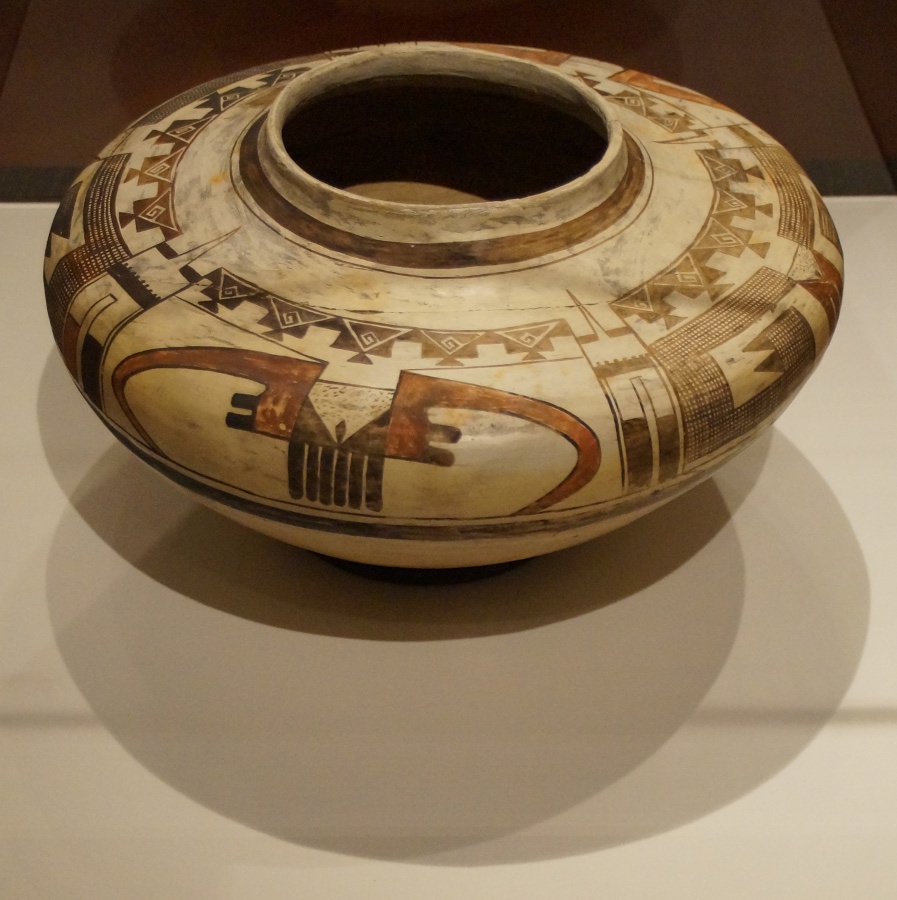
In the Rio Grande pueblos pottery is treated as a separate art genre. In the old city centres of Taos, Santa Fe and Albuquerque, where the tourists come, shops are full of big and small pots decorated in various patterns, typical of each tribe. Very decorative, the pots have no practical use, they are not glazed inside and water would leak out of them. They are treated purely as works of art produced for collectors. This ceramic madness, however, started not on the Rio Grande, but at the God-forsaken north-eastern corner of Arizona, in the Hopi country. To be precise – all Pueblo Indians both in the Rio Grande valley and in Arizona, had been producing exquisite pottery for thousands of years, but at the end of the 19th century white traders brought metal pots and the old art of pottery slowly died out as nobody needed clay pots any more. The process started earlier by the Rio Grande, which was closer to the cities of the white man. Transcontinental railway passed through Santa Fe and one could even go to New York on that. There was no railway in the Hopi country, there wasn't even a proper road there, it was much more difficult to reach. There were, however, people who wanted to reach it despite the difficulties. They were archaeologists, who dug out ancient ruins and found shreds of pottery there. The styles of pottery changed over the centuries but among the ruins only shreds could be found, not the whole beautiful pots. The archaeologists employed local Indians as manual workers at the excavations and one of them, Jesse Fawkes who worked in the Hopi country, asked his workers whether there is a potter somewhere who could make copies of the ancient pots. One of the workers said that yes, his wife could do it. The wife's name was Nampeyo.
Nampeyo
She was born around 1860 in a village of Hano in the Hopi country. She grew up in a place where two cultures met because inhabitants of Hano were immigrants there. They came in the 18th century when after the failure of the great uprising against the Spanishin the Rio Grande valley. The Spaniards persecuted those Indians who joined the rebellion and some of those rebels ran away to live among other tribes. The Hano people were among them. They built their village on a top of a mesa, just next to two existing Hopi villages, Sichimovi and Walpi. The Hano people kept their separate culture and language but geographical closeness resulted in mixed marriages and a mixing of cultures. Nampeyo is the best example of this.
In her time nobody made clay pots in the village of Hano any more, Nampeyo learned the art of pottery from her aunt who lived in Walpi. She was a keen learner, liked to experiment and was fascinated by the shreds that her husband sometimes brought from the excavation. She decorated some of her pots with ancient designs. What she produced was appreciated by archaeologists who wrote about her in the press. This, in turn, was noticed by the press, who went all the way to Hano to meet her. At that time the press were almost always men. Nampeyo had a lot of charm and this charm influenced what the press wrote about her. Charm aside, the pots she produced were of the highest quality. Collectors wanted to buy them for quite a lot of money. Today her pots sell for thousands of dollars.
As Nampeyo's popularity grew, she was invited to exhibitions in the great cities in the east. It was a really big world for a simple village girl. Demand for her pots grew so she taught her daughter and later the granddaughters how to make them. Today in Hano there is quite a lot of lady potters, descendants of Nampeyo.
Even on a stand on the car park in front of the only hotel in the Hopi country one can see echoes of the style of the great artist. Looking at one of the pots I mentioned her name and the lady seller was surprised that I know it. Clearly most of the American tourists who passed this way had no idea. I must admit that I had only known about it for a couple of days as I had learned about Nampeyo a few days before in a museum in Phoenix. The lady seller said that she herself is not from Nampeyo's family but her daughters are, because her husband is.
I am not a collector. I travel with a backpack in which there is not much room for souvenirs. This time, however, I decided to acquire a little pot in the style of the great artist. Wasn't too expensive, wasn't too big, I could fit it in my backpack. To my surprise when I bought the pot the lady seller decided to fold her stand and go home. She decided she had earned enough that day and she doesn't need to stand there any longer.

When will these Hopi learn how to run a business? When will they understand that one needs to want more and more and more, all the time, without rest? Don't they realise that if they act like this they will always live in the God-forsaken corner of Arizona, a a middle of nowhere? Or maybe they really think this is the centre of the world?

Pot made by Nampeyo in the museum in Phoenix


You will find this article, and many others, in my book "ART ETHNO".